publications
publications in reversed chronological order.
2026
- preprint
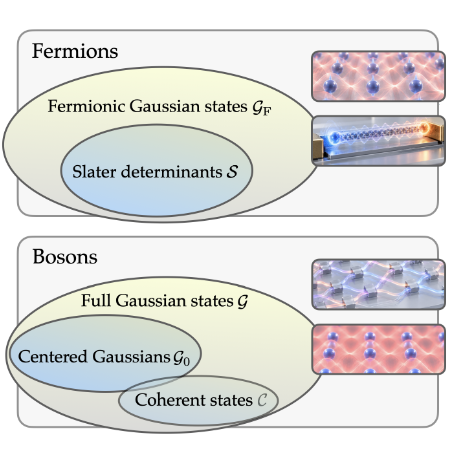 Testing quantum Gaussianity with constant sample complexityMahtab Yaghubi Rad, Ricard Puig, Saksham Hassanandani, Luke Coffman, Jens Eisert, Carlos Bravo-Prieto, and Antonio Anna MelearXiv:2609.40270, 2026
Efficiently testing whether a quantum state possesses a given structure is both a fundamental and a practical task in quantum information. Among the most important structured families are Gaussian states, which underpin quantum optics and many-body physics while defining paradigmatic regimes of efficient classical simulation. Despite the central role of Gaussian states, optimal tests of Gaussianity have remained unknown. Here we give optimal and robust algorithms for testing fermionic and bosonic Gaussian states, with sample complexity independent of system size, particle number, and energy. Remarkably, the protocols implement experimentally feasible measurements associated with known exact symmetry characterizations of Gaussianity, using Bell sampling on two copies for fermions and passive interferometry with photon counting on three copies for bosons. We further obtain tolerant testers requiring joint measurements on a larger, but still constant, number of copies. At the heart of our analysis is a unified approach, which we call the gradient-flow method, that applies across all structured families considered here and underlies our optimal testers: representation theory turns approximate satisfaction of the defining symmetry into quantitative control of the gradient of the rejection probability, allowing a continuous descent from the input state to the target family whose length bounds their distance.
- preprint
 An Optimal Quantum Linear Systems AlgorithmCarlos Bravo-Prieto, Aram W. Harrow, and Robin KothariarXiv:2609.35660, 2026
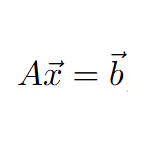
In the quantum linear systems problem (QLSP), we are given query access to a d-sparse N × N matrix A with condition number κ, and the ability to prepare a quantum state proportional to a vector b. The goal is to output an ε-approximation to the quantum state proportional to the solution x of Ax = b. Following a long line of work, the best previously known quantum algorithms for the QLSP had query complexities O(κd log(1/ε)) and κ√d(κd/ε)o(1), while the best known lower bounds were Ω(κ log(1/ε)) and Ω(κ√d). We improve these bounds and show that the complexity of the QLSP is Θ(κ√d log(1/ε)). We also resolve an open problem of Berry and Childs by showing that any N × N unitary can be implemented with bounded error using O(√N) queries to its matrix entries.
- preprint
 Cautious optimism for deep parameterized quantum circuitsMarie Kempkes, Elies Gil-Fuster, Carlos Bravo-Prieto, Aroosa Ijaz, Alissa Wilms, Jens Eisert, Evert Nieuwenburg, and Vedran DunjkoarXiv:2607.21409, 2026
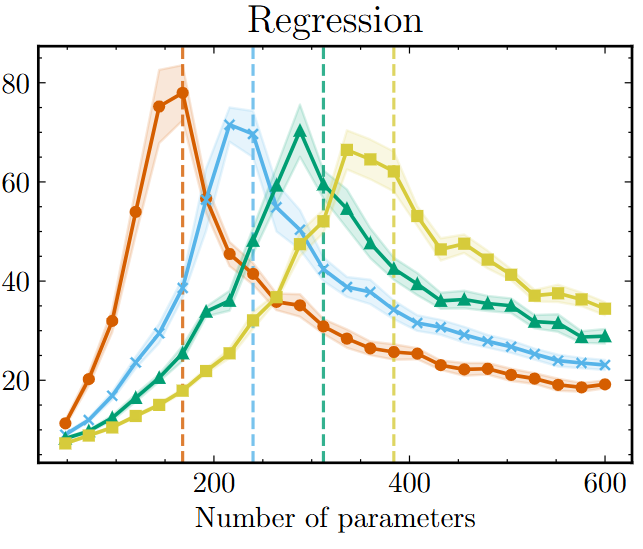
A central challenge in quantum machine learning is understanding the scaling behavior of parameterized quantum circuits (PQCs). In particular, it remains unclear how their performance on unseen data changes as the number of trainable parameters increases. Prior works have derived formal generalization guarantees for quantum models, but it is well-known that many such results do not fully characterize generalization behavior in practice. In this work, we show that gradient-based PQCs can exhibit improved performance on unseen data as model size increases, displaying the phenomenon of double descent. This contrasts with the traditional view that larger models lead to degraded generalization. We provide analytical results rigorously underpinning this behavior by leveraging add-one-in perturbation techniques and spectral properties of random matrices. We support these results with numerical experiments on re-uploading PQCs across several data sets and training set sizes, consistently observing the predicted double descent behavior. While other obstacles on the path toward practical quantum machine learning remain, our finding that deeper parameterized quantum circuits do not necessarily exhibit degraded performance provides reasons for cautious optimism.
- preprint
 Quantum memory advantage for quantum process tomographyCarlos Bravo-Prieto, Weiyuan Gong, and Antonio Anna MelearXiv:2607.13476, 2026
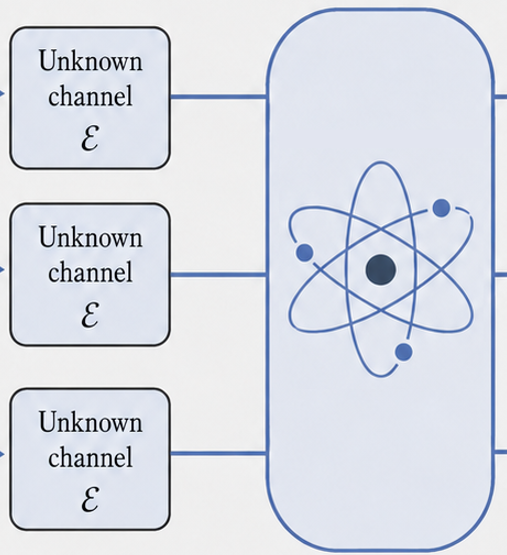
Quantum process tomography, the task of learning an unknown quantum channel from black-box access, is a central problem in quantum information. In this setting, protocols with quantum memory can coherently store and jointly process quantum information obtained from multiple channel uses, whereas protocols without quantum memory must measure after each use and retain only a classical transcript of the measurement outcomes. A fundamental open question is whether quantum memory provides a query-complexity advantage even when protocols without quantum memory may adapt their experiments based on all previous outcomes with unbounded classical computational power. In this work, we show that it does. We determine the optimal query complexity of quantum process tomography without quantum memory up to a constant factor to be Θ(din3 dout3/ε2), where din and dout are the channel input and output dimensions, respectively, and ε is the target diamond-norm accuracy. More precisely, we prove that any incoherent protocol for this task, including adaptive protocols, requires Ω(din3 dout3/ε2) queries, even when each channel use may be assisted by arbitrary fresh ancilla, and we present a non-adaptive, ancilla-free incoherent protocol achieving the matching upper bound O(din3 dout3/ε2). Our results thereby generalize the optimal sample-complexity bounds for single-copy state tomography, recovered as the special case din=1. By contrast, coherent protocols with quantum memory achieve query complexity Θ(din2 dout2/ε2). Hence, our results establish a rigorous learning separation between quantum process tomography with and without quantum memory.
- preprint
 A PAC-Bayesian approach to generalization for quantum modelsPablo Rodriguez-Grasa, Matthias C Caro, Jens Eisert, Elies Gil-Fuster, Franz J Schreiber, and Carlos Bravo-PrietoarXiv:2603.22964, 2026
Generalization is a central concept in machine learning theory, yet for quantum models, it is predominantly analyzed through uniform bounds that depend on a model’s overall capacity rather than the specific function learned. These capacity-based uniform bounds are often too loose and entirely insensitive to the actual training and learning process. Previous theoretical guarantees have failed to provide non-uniform, data-dependent bounds that reflect the specific properties of the learned solution rather than the worst-case behavior of the entire hypothesis class. To address this limitation, we derive the first PAC-Bayesian generalization bounds for a broad class of quantum models by analyzing layered circuits composed of general quantum channels, which include dissipative operations such as mid-circuit measurements and feedforward. Through a channel perturbation analysis, we establish non-uniform bounds that depend on the norms of learned parameter matrices; we extend these results to symmetry-constrained equivariant quantum models; and we validate our theoretical framework with numerical experiments. This work provides actionable model design insights and establishes a foundational tool for a more nuanced understanding of generalization in quantum machine learning.
- PRX Quantum
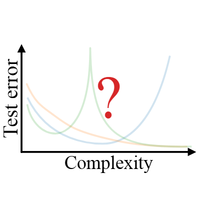 Double descent in quantum kernel methodsMarie Kempkes, Aroosa Ijaz, Elies Gil-Fuster, Carlos Bravo-Prieto, Jakob Spiegelberg, Evert Nieuwenburg, and Vedran DunjkoPRX Quantum, 2026
The double descent phenomenon challenges traditional statistical learning theory by revealing scenarios where larger models do not necessarily lead to reduced performance on unseen data. While this counterintuitive behavior has been observed in a variety of classical machine learning models, particularly modern neural network architectures, it remains elusive within the context of quantum machine learning. In this work, we analytically demonstrate that linear regression models in quantum feature spaces can exhibit double descent behavior by drawing on insights from classical linear regression and random matrix theory. Additionally, our numerical experiments on quantum kernel methods across different real-world datasets and system sizes further confirm the existence of a test error peak, a characteristic feature of double descent. Our findings provide evidence that quantum models can operate in the modern, overparameterized regime without experiencing overfitting, potentially opening pathways to improved learning performance beyond traditional statistical learning theory.
- Phys. Rev. Research
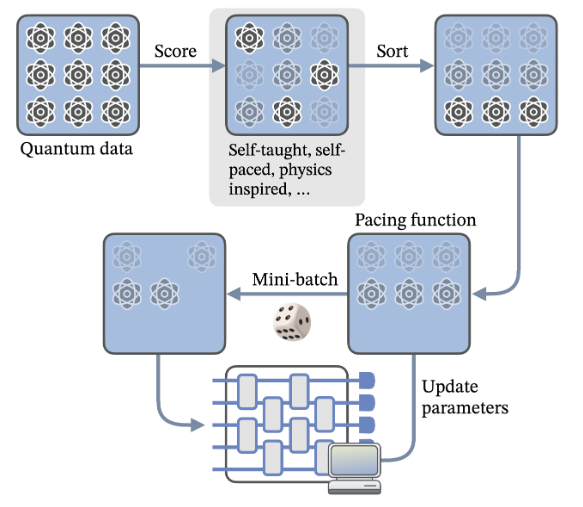 Learning complexity gradually in quantum machine learning modelsErik Recio-Armengol, Franz J Schreiber, Jens Eisert, and Carlos Bravo-PrietoPhysical Review Research, 2026
Quantum machine learning is an emergent field that continues to draw significant interest for its potential to offer improvements over classical algorithms in certain areas. However, training quantum models remains a challenging task, largely because of the difficulty in establishing an effective inductive bias when solving high-dimensional problems. In this work, we propose a training framework that prioritizes informative data points over the entire training set. This approach draws inspiration from classical techniques such as curriculum learning and hard example mining to introduce an additional inductive bias through the training data itself. By selectively focusing on informative samples, we aim to steer the optimization process toward more favorable regions of the parameter space. This data-centric approach complements existing strategies such as warm-start initialization methods, providing an additional pathway to address performance challenges in quantum machine learning. We provide theoretical insights into the benefits of prioritizing informative data for quantum models, and we validate our methodology with numerical experiments on selected recognition tasks of quantum phases of matter. Our findings indicate that this strategy could be a valuable approach for improving the performance of quantum machine learning models.
2025
- preprint
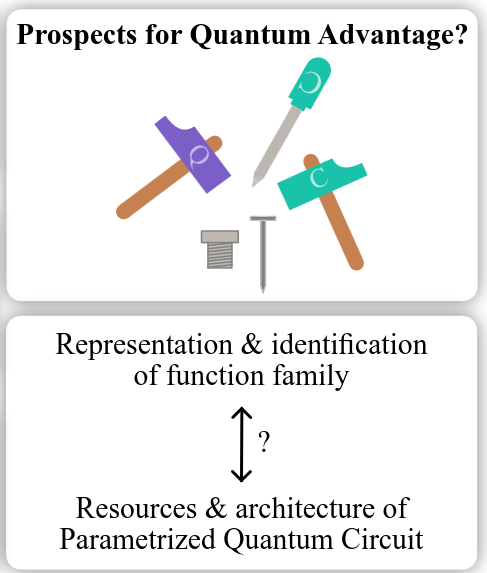 Prospects for quantum advantage in machine learning from the representability of functionsSergi Masot-Llima, Elies Gil-Fuster, Carlos Bravo-Prieto, Jens Eisert, and Tommaso GuaitaarXiv:2512.15661, 2025
Demonstrating quantum advantage in machine learning tasks requires navigating a complex landscape of proposed models and algorithms. To bring clarity to this search, we introduce a framework that connects the structure of parametrized quantum circuits to the mathematical nature of the functions they can actually learn. Within this framework, we show how fundamental properties, like circuit depth and non-Clifford gate count, directly determine whether a model’s output leads to efficient classical simulation or surrogation. We argue that this analysis uncovers common pathways to dequantization that underlie many existing simulation methods. More importantly, it reveals critical distinctions between models that are fully simulatable, those whose function space is classically tractable, and those that remain robustly quantum. This perspective provides a conceptual map of this landscape, clarifying how different models relate to classical simulability and pointing to where opportunities for quantum advantage may lie.
2024
- Nat. Comms.
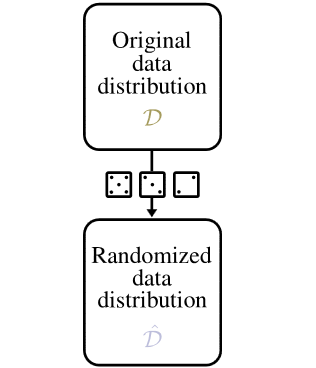 Understanding quantum machine learning also requires rethinking generalizationElies Gil-Fuster, Jens Eisert, and Carlos Bravo-PrietoNature Communications, 2024
Quantum machine learning models have shown successful generalization performance even when trained with few data. In this work, through systematic randomization experiments, we show that traditional approaches to understanding generalization fail to explain the behavior of such quantum models. Our experiments reveal that state-of-the-art quantum neural networks accurately fit random states and random labeling of training data. This ability to memorize random data defies current notions of small generalization error, problematizing approaches that build on complexity measures such as the VC dimension, the Rademacher complexity, and all their uniform relatives. We complement our empirical results with a theoretical construction showing that quantum neural networks can fit arbitrary labels to quantum states, hinting at their memorization ability. Our results do not preclude the possibility of good generalization with few training data but rather rule out any possible guarantees based only on the properties of the model family. These findings expose a fundamental challenge in the conventional understanding of generalization in quantum machine learning and highlight the need for a paradigm shift in the study of quantum models for machine learning tasks.
2023
- Quantum
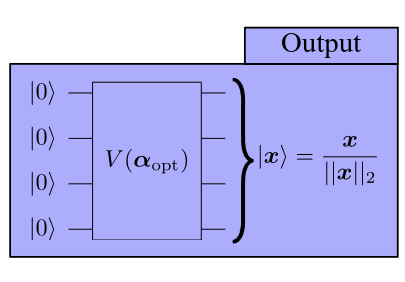 Variational quantum linear solverCarlos Bravo-Prieto, Ryan LaRose, Marco Cerezo, Yigit Subasi, Lukasz Cincio, and Patrick J ColesQuantum, 2023
Previously proposed quantum algorithms for solving linear systems of equations cannot be implemented in the near term due to the required circuit depth. Here, we propose a hybrid quantum-classical algorithm, called Variational Quantum Linear Solver (VQLS), for solving linear systems on near-term quantum computers. VQLS seeks to variationally prepare |x⟩ such that A|x⟩∝|b⟩. We derive an operationally meaningful termination condition for VQLS that allows one to guarantee that a desired solution precision ϵ is achieved. Specifically, we prove that C ⩾ ϵ²/κ², where C is the VQLS cost function and κ is the condition number of A. We present efficient quantum circuits to estimate C, while providing evidence for the classical hardness of its estimation. Using Rigetti’s quantum computer, we successfully implement VQLS up to a problem size of 1024×1024. Finally, we numerically solve non-trivial problems of size up to 250×250. For the specific examples that we consider, we heuristically find that the time complexity of VQLS scales efficiently in ϵ, κ, and the system size N.
2022
- Quantum
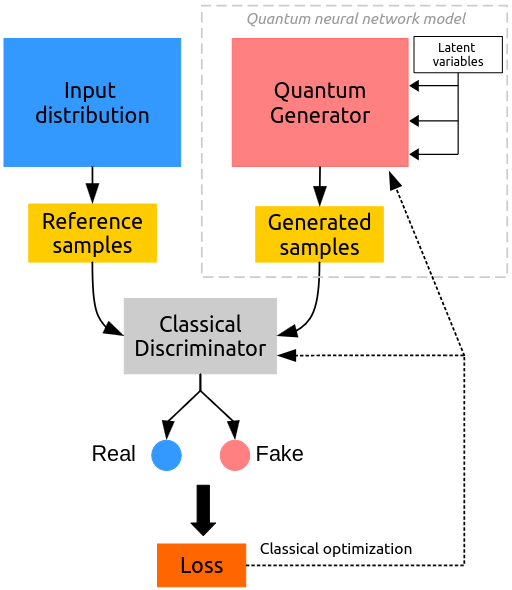 Style-based quantum generative adversarial networks for Monte Carlo eventsCarlos Bravo-Prieto, Julien Baglio, Marco Cè, Anthony Francis, Dorota M Grabowska, and Stefano CarrazzaQuantum, 2022
We propose and assess an alternative quantum generator architecture in the context of generative adversarial learning for Monte Carlo event generation, used to simulate particle physics processes at the Large Hadron Collider (LHC). We validate this methodology by implementing the quantum network on artificial data generated from known underlying distributions. The network is then applied to Monte Carlo-generated datasets of specific LHC scattering processes. The new quantum generator architecture leads to a generalization of the state-of-the-art implementations, achieving smaller Kullback-Leibler divergences even with shallow-depth networks. Moreover, the quantum generator successfully learns the underlying distribution functions even if trained with small training sample sets; this is particularly interesting for data augmentation applications. We deploy this novel methodology on two different quantum hardware architectures, trapped-ion and superconducting technologies, to test its hardware-independent viability.
- JPhysA: Math. Theor.
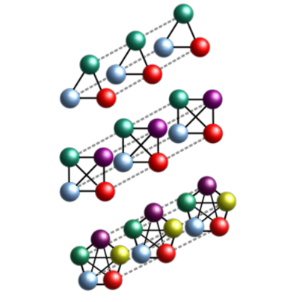 Variational quantum eigensolver for SU (N) fermionsMirko Consiglio, Wayne J Chetcuti, Carlos Bravo-Prieto, Sergi Ramos-Calderer, Anna Minguzzi, José I Latorre, Luigi Amico, and Tony JG ApollaroJournal of Physics A: Mathematical and Theoretical, 2022
Variational quantum algorithms aim at harnessing the power of noisy intermediate-scale quantum (NISQ) computers, by using a classical optimizer to train a parameterized quantum circuit to solve tractable quantum problems. The variational quantum eigensolver (VQE) is one of the aforementioned algorithms designed to determine the ground-state of many-body Hamiltonians. Here, we apply the VQE to study the ground-state properties of N-component fermions. With such knowledge, we study the persistent current of interacting SU(N) fermions, which is employed to reliably map out the different quantum phases of the system. Our approach lays out the basis for a current-based quantum simulator of many-body systems that can be implemented on NISQ computers.
- preprint
 Quantum computing for data analysis in high energy physicsAndrea Delgado, Kathleen E Hamilton, Jean-Roch Vlimant, Duarte Magano, Yasser Omar, Pedrame Bargassa, Anthony Francis, Alessio Gianelle, Lorenzo Sestini, Donatella Lucchesi, and 14 more authorsarXiv:2203.08805, 2022
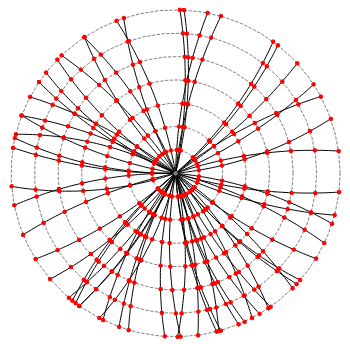
Some of the biggest achievements of the modern era of particle physics, such as the discovery of the Higgs boson, have been made possible by the tremendous effort in building and operating large-scale experiments like the Large Hadron Collider or the Tevatron. In these facilities, the ultimate theory to describe matter at the most fundamental level is constantly probed and verified. These experiments often produce large amounts of data that require storing, processing, and analysis techniques that often push the limits of traditional information processing schemes. Thus, the High-Energy Physics (HEP) field has benefited from advancements in information processing and the development of algorithms and tools for large datasets. More recently, quantum computing applications have been investigated in an effort to understand how the community can benefit from the advantages of quantum information science. In this manuscript, we provide an overview of the state-of-the-art applications of quantum computing to data analysis in HEP, discuss the challenges and opportunities in integrating these novel analysis techniques into a day-to-day analysis workflow, and whether there is potential for a quantum advantage.
- Phys. Rev. Research
 Solving systems of Boolean multivariate equations with quantum annealingSergi Ramos-Calderer, Carlos Bravo-Prieto, Ruge Lin, Emanuele Bellini, Marc Manzano, Najwa Aaraj, and José I LatorrePhysical Review Research, 2022
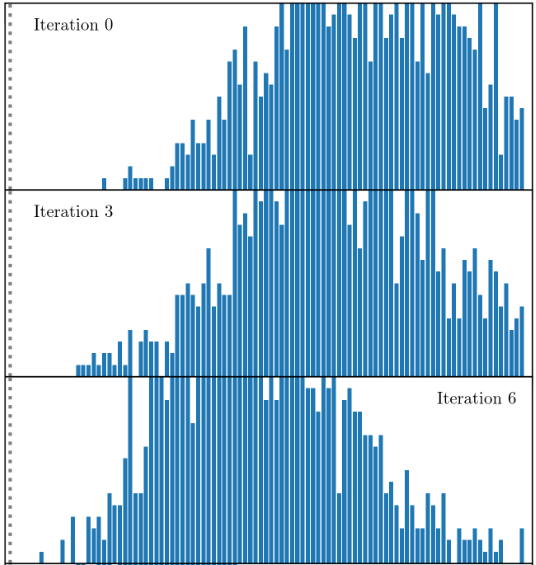
Polynomial systems over the binary field have important applications, especially in symmetric and asymmetric cryptanalysis, multivariate-based postquantum cryptography, coding theory, and computer algebra. In this paper, we study the quantum annealing model for solving Boolean systems of multivariate equations of degree 2, usually referred to as the multivariate quadratic problem. We present different methodologies to embed the problem into a Hamiltonian that can be solved by available quantum annealing platforms. In particular, we provide three embedding options, and we highlight their differences in terms of quantum resources. Moreover, we design a machine-agnostic algorithm that adopts an iterative approach to better solve the problem Hamiltonian by repeatedly reducing the search space. Finally, we use D-Wave devices to successfully implement our methodologies on several instances of the multivariate quadratic problem.
- Quantum Sci. Tech.
 Qibo: a framework for quantum simulation with hardware accelerationStavros Efthymiou, Sergi Ramos-Calderer, Carlos Bravo-Prieto, Adrián Pérez-Salinas, Diego Garcı́a-Martı́n, Artur Garcia-Saez, José Ignacio Latorre, and Stefano CarrazzaQuantum Science & Technology, 2022
We present Qibo, a new open-source software for fast evaluation of quantum circuits and adiabatic evolution which takes full advantage of hardware accelerators. The growing interest in quantum computing and the recent developments of quantum hardware devices motivates the development of new advanced computational tools focused on performance and usage simplicity. In this work we introduce a new quantum simulation framework that enables developers to delegate all complicated aspects of hardware or platform implementation to the library so they can focus on the problem and quantum algorithms at hand. This software is designed from scratch with simulation performance, code simplicity and user friendly interface as target goals. It takes advantage of hardware acceleration such as multi-threading Central Processing Unit (CPU), single Graphics Processing Unit (GPU) and multi-GPU devices.
2021
- Phys. Rev. A
 Quantum unary approach to option pricingSergi Ramos-Calderer, Adrián Pérez-Salinas, Diego Garcı́a-Martı́n, Carlos Bravo-Prieto, Jorge Cortada, Jordi Planaguma, and José I LatorrePhysical Review A, 2021
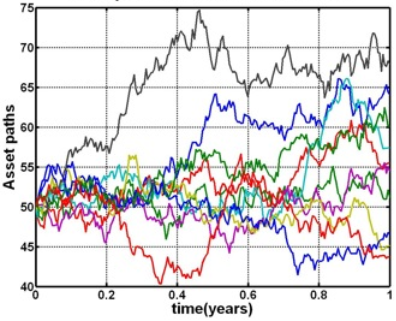
We present a quantum algorithm for European option pricing in finance, where the key idea is to work in the unary representation of the asset value. The algorithm needs novel circuitry and is divided in three parts: first, the amplitude distribution corresponding to the asset value at maturity is generated using a low-depth circuit; second, the computation of the expected return is computed with simple controlled gates; and third, standard amplitude estimation is used to gain quantum advantage. On the positive side, unary representation remarkably simplifies the structure and depth of the quantum circuit. Amplitude distributions use quantum superposition to bypass the role of classical Monte Carlo simulation. The unary representation also provides a postselection consistency check that allows for a substantial mitigation in the error of the computation. On the negative side, unary representation requires linearly many qubits to represent a target probability distribution, as compared to the logarithmic scaling of binary algorithms. We compare the performance of both unary vs binary option pricing algorithms using error maps, and find that unary representation may bring a relevant advantage in practice for near-term devices.
- MLST
 Quantum autoencoders with enhanced data encodingCarlos Bravo-PrietoMachine Learning: Science and Technology, 2021
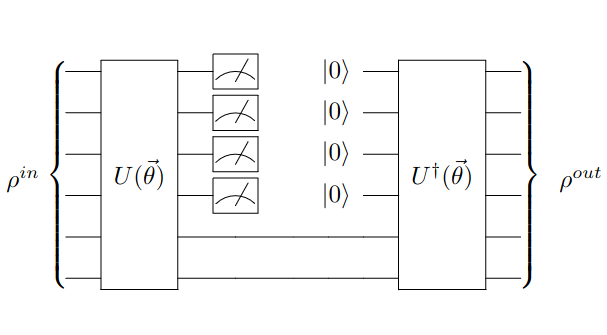
We present the enhanced feature quantum autoencoder, or EF-QAE, a variational quantum algorithm capable of compressing quantum states of different models with higher fidelity. The key idea of the algorithm is to define a parameterized quantum circuit that depends upon adjustable parameters and a feature vector that characterizes such a model. We assess the validity of the method in simulations by compressing ground states of the Ising model and classical handwritten digits. The results show that EF-QAE improves the performance compared to the standard quantum autoencoder using the same amount of quantum resources, but at the expense of additional classical optimization. Therefore, EF-QAE makes the task of compressing quantum information better suited to be implemented in near-term quantum devices.
2020
- Phys. Rev. A
 Quantum singular value decomposerCarlos Bravo-Prieto, Diego Garcı́a-Martı́n, and José I LatorrePhysical Review A, 2020
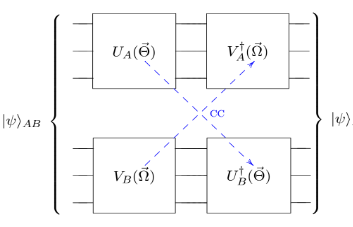
We present a variational quantum circuit that produces the singular value decomposition of a bipartite pure state. The proposed circuit, which we name quantum singular value decomposer or QSVD, is made of two unitaries respectively acting on each part of the system. The key idea of the algorithm is to train this circuit so that the final state displays exact output coincidence from both subsystems for every measurement in the computational basis. Such circuit preserves entanglement between the parties and acts as a diagonalizer that delivers the eigenvalues of the Schmidt decomposition. Our algorithm only requires measurements in one single setting, in striking contrast to the 3n settings required by state tomography. Furthermore, the adjoints of the unitaries making the circuit are used to create the eigenvectors of the decomposition up to a global phase. Some further applications of QSVD are readily obtained. The proposed QSVD circuit allows us to construct a SWAP between the two parties of the system without the need of any quantum gate communicating them. We also show that a circuit made with QSVD and CNOTs acts as an encoder of information of the original state onto one of its parties. This idea can be reversed and used to create random states with a precise entanglement structure.
- Quantum
 Scaling of variational quantum circuit depth for condensed matter systemsCarlos Bravo-Prieto, Josep Lumbreras-Zarapico, Luca Tagliacozzo, and José I LatorreQuantum, 2020
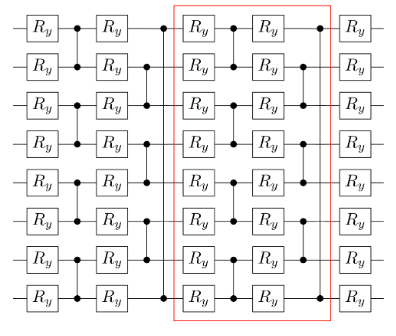
We benchmark the accuracy of a variational quantum eigensolver based on a finite-depth quantum circuit encoding ground state of local Hamiltonians. We show that in gapped phases, the accuracy improves exponentially with the depth of the circuit. When trying to encode the ground state of conformally invariant Hamiltonians, we observe two regimes. A finite-depth regime, where the accuracy improves slowly with the number of layers, and a finite-size regime where it improves again exponentially. The cross-over between the two regimes happens at a critical number of layers whose value increases linearly with the size of the system. We discuss the implication of these observations in the context of comparing different variational ansatz and their effectiveness in describing critical ground states.
- Entropy
 Measuring the tangle of three-qubit statesAdrián Pérez-Salinas, Diego Garcı́a-Martı́n, Carlos Bravo-Prieto, and José I LatorreEntropy, 2020
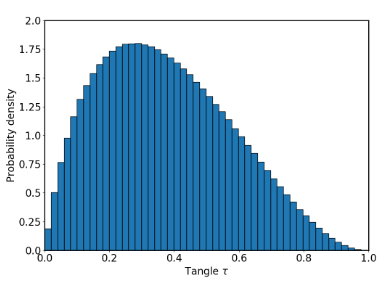
We present a quantum circuit that transforms an unknown three-qubit state into its canonical form, up to relative phases, given many copies of the original state. The circuit is made of three single-qubit parametrized quantum gates, and the optimal values for the parameters are learned in a variational fashion. Once this transformation is achieved, direct measurement of outcome probabilities in the computational basis provides an estimate of the tangle, which quantifies genuine tripartite entanglement. We perform simulations on a set of random states under different noise conditions to asses the validity of the method.